錒系元素
| 原子序數 | 名稱 | 符號 |
|---|---|---|
| 89 | 錒 | Ac |
| 90 | 釷 | Th |
| 91 | 鏷 | Pa |
| 92 | 鈾 | U |
| 93 | 錼 | Np |
| 94 | 鈽 | Pu |
| 95 | 鋂 | Am |
| 96 | 鋦 | Cm |
| 97 | 鉳 | Bk |
| 98 | 鉲 | Cf |
| 99 | 鑀 | Es |
| 100 | 鐨 | Fm |
| 101 | 鍆 | Md |
| 102 | 鍩 | No |
| 103 | 鐒 | Lr |
錒系元素是第89號元素錒到103號元素鐒共15種放射性元素的統稱。錒系元素位於元素週期表第7週期的鐳與鑪之間,位於鑭系元素下方,但通常為了避免週期表橫向過於冗長影響觀看,而將鑭系和錒系元素移至週期表下方獨立列出。錒系元素也屬於過渡元素,只是錒系元素的外層和次外層的電子構型基本相同,新增加的電子則大都填入從外側數第三個電子層(即5f電子層)中,所以錒系元素又可以稱為5f系,位於元素週期表中的f區。為了區別於周期表中的d區過渡元素,故又將錒系元素及鑭系元素合稱為內過渡元素。由於錒系元素都是金屬,所以又可以和鑭系元素統稱為f區金屬。錒系元素用符號An表示。
1789年德國馬丁·克拉普羅特從瀝青鈾礦中發現鈾,它是被人們認識的第一個錒系元素。其後陸續發現釷、錒和鏷。鈾以後的元素(即超鈾元素)都是在1940年後用人工核反應合成的,屬於人工合成元素,不過也有部分超鈾元素最初是通過人工合成的方式發現,但是後來在自然界中,也發現有痕跡量的存在,例如錼和鈽等。
和鑭系元素相比,較輕的錒系元素彼此之間的化合價有較多的變化,因此相似度沒有鑭系元素來的高,而較重的錒系元素則因為錒系收縮現象的減緩而使得彼此之間的相似性較高,因而造成分離上的困難。
錒系元素原子基態的電子構型是5f0~146d0~17s2,這些元素的核外電子分為7層,最外層都是2個電子,次外層多數為8個電子(個別為9或10個電子),從鏷到鍩電子填入第5層,使第5層電子數從18個增加到32個。
性質
| 元素名稱 | 錒 | 釷 | 鏷 | 鈾 | 錼 | 鈽 | 鋂 | 鋦 | 鉳 | 鉲 | 鑀 | 鐨 | 鍆 | 鍩 | 鐒 |
|---|---|---|---|---|---|---|---|---|---|---|---|---|---|---|---|
| 原子序 | 89 | 90 | 91 | 92 | 93 | 94 | 95 | 96 | 97 | 98 | 99 | 100 | 101 | 102 | 103 |
| 圖片 |  |
 |
 |
 |
 |
 |
 |
 |
 |
無 | 無 | 無 | 無 | ||
| 原子量 | 227.03 | 232.04 | 231.04 | 238.03 | 237.05 | [244] | [243] | [247] | [247] | [251] | [252] | [257] | [258] | [259] | [266] |
| 天然同位素數量 | 3 | 7 | 3 | 8 | 3 | 4 | 0 | 0 | 0 | 0 | 0 | 0 | 0 | 0 | 0 |
| 最長壽同位素 | 227 | 232 | 231 | 238 | 237 | 244 | 243 | 247 | 247 | 251 | 252 | 257 | 258 | 259 | 266 |
| 最長壽同位素之半衰期 | 21.8年 | 140億年 | 32500年 | 44.7億年 | 214萬年 | 8080萬年 | 7370年 | 1560萬年 | 1380年 | 900年 | 1.29年 | 100.5天 | 52天 | 58分鐘 | 11小時 |
| 密度(g/cm3)[1] | 10.07 | 11.724 | 15.37 | 19.05 | 20.45 | 19.816 | 13.67 | 13.51 | 14.78 | 15.1 | - | - | - | - | - |
| 熔點(°C) | 1050 | 1842 | 1568 | 1132.2 | 639 | 639.4 | 1176 | 1340 | 986 | 900 | 860 | 1530 | 830 | 830 | 1630 |
| 沸點(°C) | 3198 | 4788 | 4027? | 4131 | 4174? | 3228 | 2607? | 3110 | 2627 | 1470? | 996? | — | — | — | — |
|
電子組態 (氣相) |
6d17s2 | 6d27s2 | 5f26d17s2 或 5f16d27s2 |
5f36d17s2 | 5f46d17s2 或 5f57s2 |
5f67s2 | 5f77s2 | 5f76d17s2 | 5f97s2 或 5f86d17s2 |
5f107s2 | 5f117s2 | 5f127s2 | 5f137s2 | 5f147s2 | 5f147s27p1 |
| 電子組態 (固相) |
6d17s2 | 5f0.56d1.57s2 | 5f1.76d1.37s2 | 5f2.96d1.17s2 | 5f46d17s2 | 5f56d17s2 | 5f66d17s2 | 5f76d17s2 | 5f86d17s2 | 5f96d17s2 | 5f117s2 | 5f127s2 | 5f137s2 | 5f147s2 | 5f146d17s2 |
| 金屬半徑(pm) | 203 | 180 | 162 | 153 | 150 | 162 | 173 | 174 | 170 | 186 | 186 | ? 198 | ? 194 | ? 197 | ? 171 |
錒系元素皆為銀灰色有光澤的放射性金屬[2][3][4][5],半衰期隨著原子序的擴大而依次縮短。錒系元素的性質較軟,具有較高的密度及可塑性,在空氣中會失去光澤。[6]與鑭系元素一樣,錒系元素的化學性質比較活潑,能形成錯合物及可溶於水的氯化物、硫酸鹽、硝酸鹽及高氯酸鹽等,至於它們的氫氧化物、氟化物、硫酸鹽及草酸鹽等則不溶於水。
爭論
鐒(Lr)是否屬於錒系元素有爭論。最近的色譜分析顯示,鐒應屬於IIIB族,而非錒系。但為了方便敘述,現今仍習慣將其與錒系合稱。參見鑭系元素中關於鑥的地位的爭論。
原子半徑和離子半徑(錒系收縮)
與同族的鈧、釔、鑭、錒原子半徑逐漸增大的規律恰恰相反,從釷到鐒則是逐漸減小。這種錒系元素的原子半徑和離子半徑隨原子序數的增加而逐漸減小的現象稱為錒系收縮。
錒系元素中,充填最初幾個元素的5f電子時,離子半徑收縮地比較明顯,但此現象後來趨於平緩,使得這些較重的錒系元素的離子半徑十分接近。因此錒系元素在化學性質上的差別隨著原子序數的增大而逐漸變小,以致逐個地分離錒系元素(尤其是重錒系元素)越來越困難。
| 原子序數 | 元素名稱 | +3離子半徑(pm) | +4離子半徑(pm) |
|---|---|---|---|
| 90 | 釷(Th) | 108 | 99 |
| 91 | 鏷(Pa) | 105 | 93 |
| 92 | 鈾(U) | 103 | 93 |
| 93 | 錼(Np) | 101 | 92 |
| 94 | 鈽(Pu) | 100 | 90 |
| 95 | 鋂(Am) | 99 | 89 |
| 96 | 鋦(Cm) | 98 | 88 |
| 97 | 鉳(Bk) | —— | —— |
| 98 | 鉲(Cf) | —— | —— |
| 99 | 鑀(Es) | —— | —— |
| 100 | 鐨(Fm) | —— | —— |
| 101 | 鍆(Md) | —— | —— |
| 102 | 鍩(No) | —— | —— |
| 103 | 鐒(Lr) | —— | —— |
離子的顏色
| 氧化態 | 錒 | 釷 | 鏷 | 鈾 | 錼 | 鈽 | 鋂 | 鋦 | 鉳 | 鉲 | 鑀 | 鐨 | 鍆 | 鍩 | 鐒 |
| +2 | Fm2+ | Md2+ | No2+ | ||||||||||||
| +3 | Ac3+ | Th3+ | Pa3+ | U3+ | Np3+ | Pu3+ | Am3+ | Cm3+ | Bk3+ | Cf3+ | Es3+ | Fm3+ | Md3+ | No3+ | Lr3+ |
| +4 | Th4+ | Pa4+ | U4+ | Np4+ | Pu4+ | Am4+ | Cm4+ | Bk4+ | Cf4+ | ||||||
| +5 |
PaO+ 2 |
UO+ 2 |
NpO+ 2 |
PuO+ 2 |
AmO+ 2 |
||||||||||
| +6 |
UO2+ 2 |
NpO2+ 2 |
PuO2+ 2 |
AmO2+ 2 |
|||||||||||
| +7 |
NpO3+ 2 |
PuO3+ 2 |
AmO3− 5 |
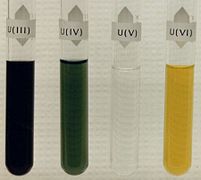
鈾的3、4、5、6價鹽的水溶液

錼的3、4、5、6、7價鹽的水溶液

鈽的3、4、5、6、7價鹽的水溶液


存量及合成
地殼中含量最豐富的錒系元素為釷和鈾,它們兩者具有很長的半衰期,放射性較微弱,因此能在地殼中以穩定的量存在。主要的含鈾礦物有釩酸鉀鈾礦和鈣鈾雲母等,而釷主要分布在獨居石、方釷石和釷石等礦物中。大多數含釷礦物中皆含有鈾,反之亦然,且這些礦物中也都含有大量的稀土元素。
鏷和錒主要分布在各種鈾礦及釷礦中,含量甚微,且因化學性質與礦石中的鑭系元素相似而難以提取、分離,因此通常是從用過核燃料中提煉,或在核反應爐中人工製成。
超鈾元素大多不存在於自然界中,必須透過核反應爐或粒子加速器人工合成,只有部分較輕的元素如錼和鈽等以痕量存在於鈾礦中。
用途
儘管部分錒系元素已在日常生活中得到了應用,例如煙霧偵測器中的鋂[8][9]和煤氣網罩中的釷等[10],但錒系元素主要用於核武器,或當作核反應爐的燃料,例如鈾和鈽等。而原子序較大的重錒系元素由於製備的難度較高,且較不穩定,因此只用於學術研究,而沒有實際用途。
在核反應爐最重要的同位素是鈾-235。它被用於如核反應爐,且在天然鈾里有0.72%的鈾-235。它強烈吸收熱中子,然後放出能量。鈾235核子吸收中子後,會裂變成2個較輕的核子和2至3顆中子,如:
1克235U的一次裂變行為轉換為大約1MW/天。重要的是,235
92U
發射的中子多於吸收的中子;[11] 達到臨界質量時,235
92U
進入自動鏈鎖反應。[12]
| Nuclear reactor[12][13][14] |
The core of most Generation II nuclear reactors contains a set of hollow metal rods, usually made of zirconium alloys, filled with solid nuclear fuel pellets – mostly oxide, carbide, nitride or monosulfide of uranium, plutonium or thorium, or their mixture (the so-called MOX fuel). The most common fuel is oxide of uranium-235.
 Fast neutrons are slowed by moderators, which contain water, carbon, deuterium, or beryllium, as thermal neutrons to increase the efficiency of their interaction with uranium-235. The rate of nuclear reaction is controlled by introducing additional rods made of boron or cadmium or a liquid absorbent, usually boric acid. Reactors for plutonium production are called breeder reactor or breeders; they have a different design and use fast neutrons. |
釷除了用作煤氣網罩的材料之外[10],也常和鎂、鋁等金屬做成合金,因為鎂釷合金不但堅固,還具有高熔點及高延展性,因此被廣泛用於航空工業和導彈的生產中。釷還有著良好的電子發射性能,可用作電子器件中的高效電子發射極。此外釷的半衰期很長[11],和鈾同位素的相對含量被廣泛用於估算包括恆星在內的各種物體的年齡(參見放射性定年法)。[15]
鈽元素的主要用途是製造核武器,尤其是可以裂變的鈽-239。它的臨界質量是鈾-235的1/3。[16]
Plutonium-238 is potentially more efficient isotope for nuclear reactors, since it has smaller critical mass than uranium-235, but it continues to release much thermal energy (0.56 W/g)[9][19] by decay even when the fission chain reaction is stopped by control rods. Its application is limited by the high price (about US$1000/g). This isotope has been used in thermopiles and water distillation systems of some space satellites and stations. So Galileo and Apollo spacecraft (e.g. Apollo 14[20]) had heaters powered by kilogram quantities of plutonium-238 oxide; this heat is also transformed into electricity with thermopiles. The decay of plutonium-238 produces relatively harmless alpha particles and is not accompanied by gamma-irradiation. Therefore, this isotope (~160 mg) is used as the energy source in heart pacemakers where it lasts about 5 times longer than conventional batteries.[9]
錒-227是中子源。 Its high specific energy (14.5 W/g) and the possibility of obtaining significant quantities of thermally stable compounds are attractive for use in long-lasting thermoelectric generators for remote use. 228Ac is used as an indicator of radioactivity in chemical research, as it emits high-energy electrons (2.18 MeV) that can be easily detected. 228Ac-228Ra mixtures are widely used as an intense gamma-source in industry and medicine.[21]具有耐用晶體基質的自發光錒系元素摻雜材料的開發是錒系元素利用的一個新領域,因為向某些玻璃和晶體中添加α發射放射性核素可能會賦予發光性。[22]
對生物的影響
由於錒系元素皆具有放射性,對生物而言具有極高的毒性,過度暴露在它們散發出的輻射中會損害人體健康。因此含有錒系元素的核廢料的處置是一個至關重要的課題。[22]
參見
參考文獻
- ^ 存档副本. [2019-12-15]. (原始內容存檔於2019-04-04).
- ^ Theodore Gray. The Elements: A Visual Exploration of Every Known Atom in the Universe. New York: Black Dog & Leventhal Publishers. 2009: 240. ISBN 978-1-57912-814-2.
- ^ Actinide element (頁面存檔備份,存於網際網路檔案館), Encyclopædia Britannica on-line
- ^ Although "actinoid"(rather than "actinide")means "actinium-like" and therefore should exclude actinium, that element is usually included in the series.
- ^ Neil G. Connelly; et al. Elements. Nomenclature of Inorganic Chemistry. London: Royal Society of Chemistry. 2005: 52 [2014-03-31]. ISBN 0-85404-438-8. (原始內容存檔於2014-01-01).
- ^ Greenwood, p. 1264
- ^ Greenwood, p. 1265
- ^ Smoke Detectors and Americium, Nuclear Issues Briefing Paper 35, May 2002
- ^ 9.0 9.1 9.2 Greenwood, p. 1262
- ^ 10.0 10.1 Greenwood, p. 1255
- ^ 11.0 11.1 Golub, pp. 220–221
- ^ 12.0 12.1 Yu.D. Tretyakov (編). Non-organic chemistry in three volumes. Chemistry of transition elements 3. Moscow: Academy. 2007. ISBN 978-5-7695-2533-9.
- ^ G. G. Bartolomei; V. D. Baybakov; M. S. Alkhutov; G. A. Bach. Basic theories and methods of calculation of nuclear reactors. Moscow: Energoatomizdat. 1982.
- ^ Greenwood, pp. 1256–1261
- ^ Sergey Popov; Alexander Sergeev. Universal Alchemy. Vokrug Sveta. 2008, 2811 (4) [2019-10-15]. (原始內容存檔於2019-10-21) (俄語).
- ^ David L. Heiserman. Element 94: Plutonium. Exploring Chemical Elements and their Compounds. New York: TAB Books. 1992: 338. ISBN 978-0-8306-3018-9.
- ^ John Malik. The Yields of the Hiroshima and Nagasaki Explosions (PDF). Los Alamos. September 1985: Table VI [15 February 2009]. LA-8819. (原始內容存檔 (PDF)於24 February 2009).
- ^ FAS contributors. Nuclear Weapon Design. Federation of American Scientists. 1998 [7 December 2008]. (原始內容存檔於26 December 2008).
- ^ John Holdren and Matthew Bunn Nuclear Weapons Design & Materials. Project on Managing the Atom (MTA) for NTI. 25 November 2002
- ^ Apollo 14 Press Kit – 01/11/71 (頁面存檔備份,存於網際網路檔案館), NASA, pp. 38–39
-
^ 引用錯誤:沒有為名為
Himiya aktiniya的參考文獻提供內容 - ^ 22.0 22.1 B.E. Burakov; M.I Ojovan; W.E. Lee. Crystalline Materials for Actinide Immobilisation. World Scientific. 2010 [2019-10-15]. ISBN 978-1848164185. (原始內容存檔於2020-03-17).